The Formaldehyde Emissions Estimator (opens in a new tab) lets a homeowner estimate indoor air formaldehyde from laminate flooring based on the characteristics of their own house.
Background
In 2015, a major flooring retailer faced scrutiny after reports that some of its laminate flooring, made by Chinese suppliers, contained more formaldehyde than California Air Resources Board rules allow. A high concentration in a product does not by itself mean high exposure. Exposure depends on how much flooring is installed, how much air moves through the house, and how fast the product off-gasses. Formaldehyde levels in flooring also fall over time.
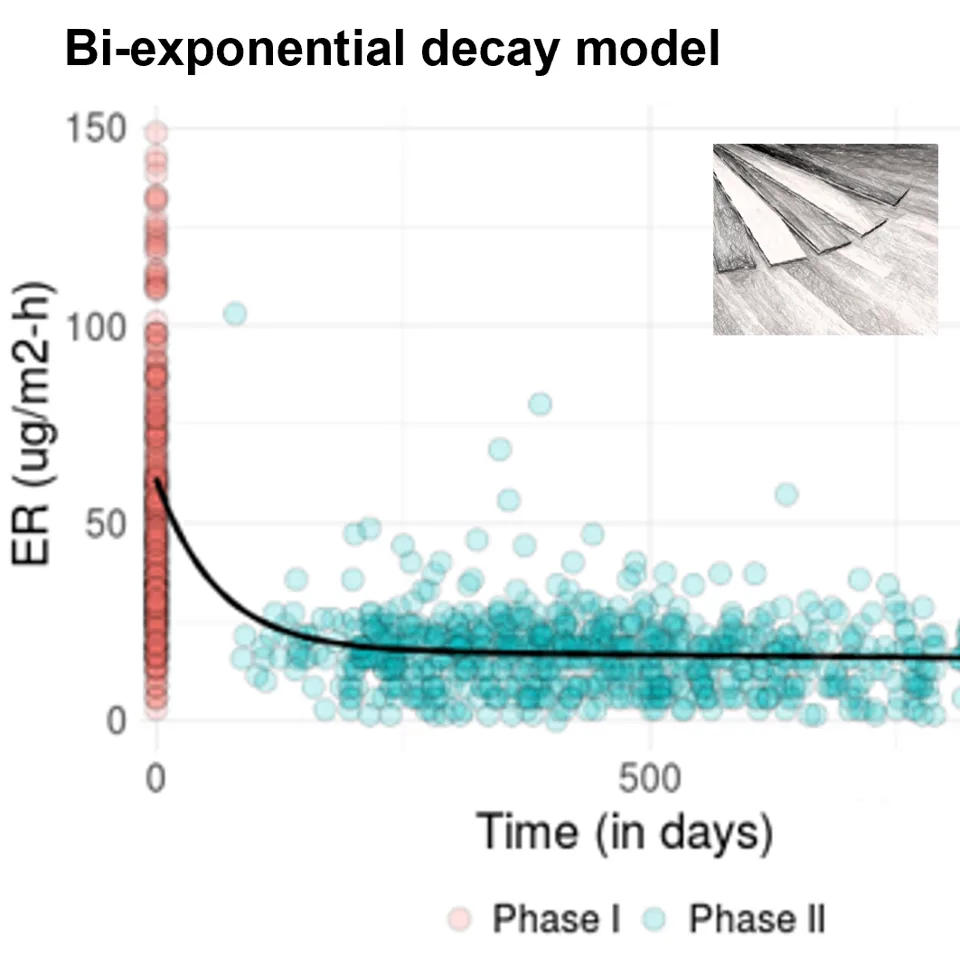
We were asked to work out long-term exposures and cancer risk compared with benchmarks such as California’s Proposition 65 level of 40 µg/day. I led a team of analytical chemists, polymer scientists, exposure assessors, and air modelers. We collected what was then the largest consumer product dataset of its kind and built a bi-exponential model of emissions over time. The work was presented to the U.S. Consumer Product Safety Commission and published in Risk Analysis (opens in a new tab).
The app puts that model in a form anyone can adjust. Change the house parameters and it returns the expected indoor concentration and risk.
Disclosure: we were retained by the flooring retailer, and some of the work supported litigation.